Guide 02 · Choosing Your Hotel Investment
Thank you for reading this post, don't forget to subscribe!How to Invest in Hotels: 4 Ways Compared
There is more than one way to invest in hotels. You can buy hotel REIT shares, own a specific hotel or condo-hotel unit, purchase a branded residence, or invest through a private hotel fund. Each gives you very different liquidity, ownership rights, income and risk.
New to hotel investing? Start with our Hotel Investment 101 guide for the fundamentals before comparing the investment structures below.
How can you invest in hotels?
For most investors, hotel investment falls into four broad categories: publicly traded hotel REITs, direct ownership of hotel or condo-hotel property, branded residences, and private hotel investment funds.
The important distinction is not simply which hotel or brand you like. It is what you actually own, how your income is generated, how easily you can sell the investment and which risks you are accepting.
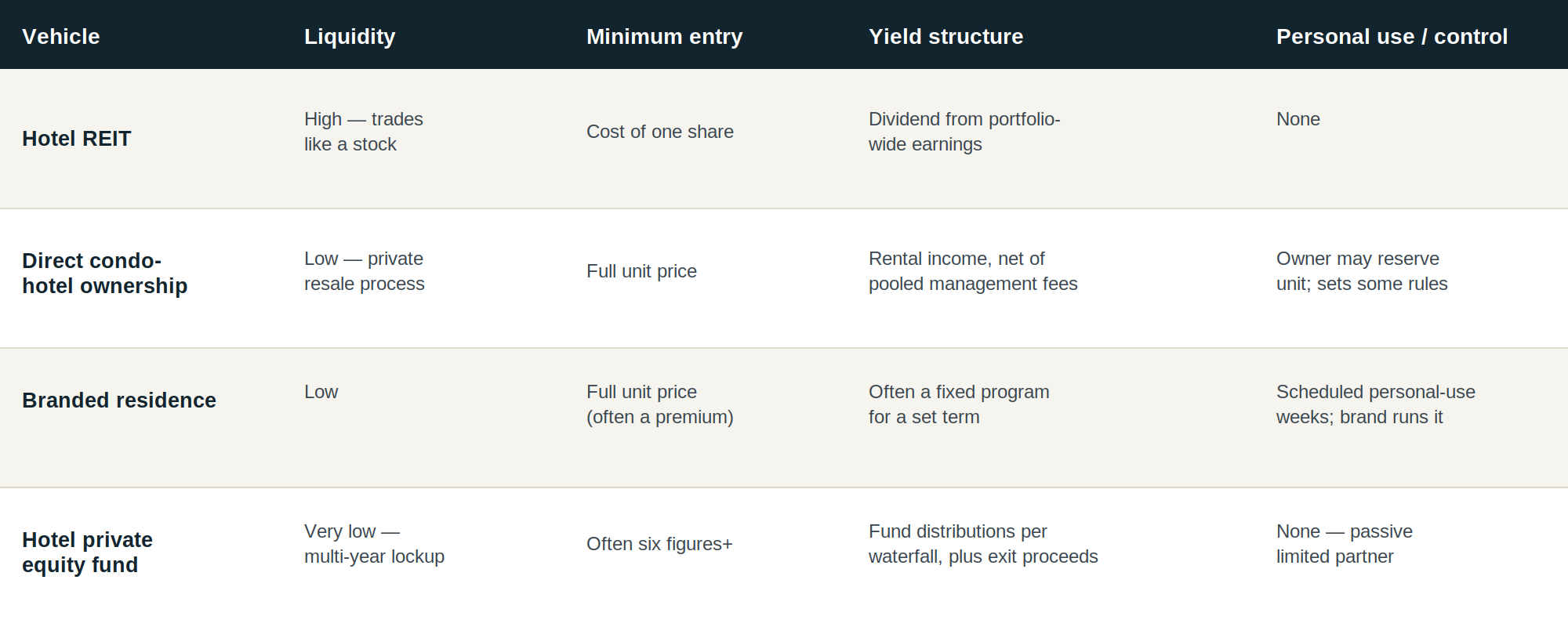
1. Hotel REITs: liquid and diversified
A hotel real estate investment trust, or hotel REIT, owns interests in a portfolio of hospitality properties. Investors purchase shares rather than buying a particular hotel room or apartment.
For publicly traded REITs, buying and selling shares can be similar to trading other listed securities. That gives investors considerably more liquidity than direct hotel property ownership.
The trade-off is that you do not own a specific hotel unit and receive no personal-use rights. Your investment is also exposed to financial-market factors such as interest rates and broader equity-market sentiment as well as the operating performance of the underlying hotel portfolio.
Best fit: investors who want diversified hospitality exposure and relatively easy entry and exit without owning or managing an individual property.
2. Direct hotel and condo-hotel ownership
Direct ownership means purchasing a specific property or unit rather than shares in a company or fund. Depending on the development, this could be a hotel suite, condo-hotel apartment or other individually owned hospitality unit.
The attraction is straightforward: you own an identifiable real estate asset. Depending on the contract, you may also have personal-use rights and the ability to participate in a managed rental programme.
Direct ownership is considerably less liquid than publicly traded securities. Selling requires finding a buyer for the particular property, and investment performance depends heavily on location, purchase price, developer quality, management costs and rental demand.
Best fit: investors who specifically want deeded real estate and are comfortable evaluating an individual property and its management structure.
3. Branded residences
A branded residence combines individually owned real estate with the name, standards and services of a hospitality or luxury brand. Some are connected directly to hotels, while others operate as standalone branded residential developments.
The brand can provide meaningful value through design standards, service standards, amenities, distribution, recognition and, depending on the project, professional rental management.
But the brand name does not automatically guarantee the investor's return.
Any fixed or guaranteed rental yield should be treated as a separate contractual arrangement. Investors need to establish which legal entity is responsible for making the payment, how long the arrangement lasts and what happens afterward.
Our guide to guaranteed rental yield programs explains what to check before relying on an advertised return.
Best fit: investors who want a specific property with professional hospitality services and potentially personal-use rights, and who are comfortable evaluating the developer, operator and individual contract.
4. Hotel private equity and investment funds
Private hotel funds pool investor capital to acquire, develop or reposition hospitality assets. Instead of owning a particular unit, the investor normally owns an interest in the investment vehicle.
These structures can provide access to larger hotel transactions and professional asset management, but minimum investments may be substantial and capital can remain committed for several years.
Unlike publicly traded hotel REITs, there may be no simple secondary market through which an investor can sell whenever they choose.
Best fit: investors with patient capital who want professionally managed exposure to hotel assets without personal use or direct control over individual properties.
What does “investing in Marriott or Hilton” actually mean?
This phrase causes unnecessary confusion because investing in a hospitality brand can mean several completely different things.
Buying company shares
You own shares in the hospitality company. You do not own a particular Marriott, Hilton or other branded hotel room.
Owning a hotel franchise
You or your company own or develop a hotel and enter into an agreement to operate it under the hospitality brand. This requires substantially more capital and involvement.
Buying branded property
You purchase a specific residence, apartment or hotel unit associated with the brand under the project's particular ownership and management structure.
Investing through a REIT
You purchase shares in a real estate company or trust whose portfolio may contain hotels operating under major international brands.
Always identify the legal and investment structure first. The brand name alone does not tell you what you are actually buying.
Hotel REIT vs. direct hotel property
This is one of the most important decisions for an individual hotel investor.
A publicly traded hotel REIT prioritizes liquidity and diversification. Direct hotel property prioritizes tangible ownership and potentially greater control or personal use.
Liquidity
Publicly traded REIT shares can generally be sold much more quickly than an individual hotel property.
Diversification
A REIT can provide exposure to multiple properties, while a direct purchase concentrates capital in one specific asset.
Personal use
Direct property may provide personal-use rights. A REIT investment does not.
Control
Direct owners may have contractual rights relating to their unit, while REIT shareholders do not control individual hotel properties.
How hotel investment income works
Different hotel investment structures produce income in different ways.
A hotel REIT may distribute income to shareholders. A private fund may generate returns from hotel operations and eventual asset sales. Direct hotel property may produce rental income under a management agreement.
Some direct-property developments advertise a fixed or guaranteed return. Others pool hotel revenue and distribute an owner's share according to a contractual formula.
When comparing investments, look beyond the headline percentage and establish:
- whether the quoted return is gross or net;
- which management and service charges apply;
- who is legally responsible for any guaranteed payment;
- how long a fixed-return period lasts;
- how income is calculated after that period;
- whether personal use reduces rental income;
- what maintenance and refurbishment costs the owner bears; and
- what taxes may apply to your circumstances.
Which hotel investment fits you?
I want liquidity
You want hospitality exposure but also want the ability to enter and exit relatively easily through public markets.
→ Hotel REITI want to own real estate
You want a specific, title-deeded property and are comfortable with the risks and costs of an individual asset.
→ Direct hotel ownershipI want ownership plus hospitality services
You value an international brand, resort amenities, professional management and potentially personal-use rights.
→ Branded residenceI want institutional exposure
You have longer-term capital and prefer a professional manager to select and operate a portfolio of hotel investments.
→ Private hotel fundRisks of investing in hotels
Hotel investments combine real estate risk with operating-business risk. Even a well-located property can perform poorly if the purchase price, financing, management structure or operating assumptions are wrong.
Occupancy risk
Hotel income depends on demand. Seasonality, competition and changes in tourism can affect both occupancy and room rates.
Management risk
The operator's ability to price, market and manage the property can materially affect investment performance.
Development risk
Off-plan hotel property introduces construction, completion and developer risk before the asset begins operating.
Liquidity risk
Direct hotel property and private funds can take considerably longer to exit than publicly traded investments.
Cost risk
Management fees, service charges, maintenance, refurbishment and other expenses can materially reduce headline yields.
Contract risk
Rental guarantees, owner-use rights, management agreements and resale restrictions are only as useful as the actual contractual terms.
How to evaluate a direct hotel investment
If you decide direct ownership or a branded residence fits your objectives, evaluate the underlying property rather than choosing on brand or advertised yield alone.
- Location: What creates accommodation demand and how seasonal is it?
- Developer: What has the company previously completed?
- Operator: Who actually manages the hotel?
- Brand: What does the brand agreement provide?
- Purchase price: How does it compare with relevant alternatives?
- Income: What realistic net income remains after costs?
- Contract: Who is responsible for each financial obligation?
- Personal use: What restrictions apply?
- Resale: Who is likely to buy the property from you later?
Hotel investment opportunities on Georgia's Black Sea coast
Georgia's Black Sea coast provides a useful real-world example of these structures. Investors can find conventional apartments, hotel units, branded residences and large resort developments across Batumi, Gonio, Chakvi and Kobuleti.
The underlying structures can look similar in marketing material while producing very different ownership rights, income arrangements and risks.
Continue with our Black Sea Coast hotel investment guide to compare the principal coastal markets.
For a specific emerging resort market, see our Kobuleti hotel investment guide.
Frequently asked questions
Can individuals invest in hotels?
Yes. Depending on available investments and eligibility, individuals may obtain hotel exposure through publicly traded securities, direct hotel property, branded residences or private investment vehicles.
Do I have to buy an entire hotel?
No. Direct hotel investment can include individually owned units, while REITs and funds provide hotel exposure without purchasing an entire property.
Are hotel investments passive?
They can be. REITs and managed funds are generally hands-off for the investor, while direct property can also be professionally managed under a hotel or rental programme.
Does a hotel brand guarantee rental income?
No. Branding and guaranteed rental income are separate arrangements. Any income guarantee should identify the legal entity responsible for payment and its contractual terms.
Can I stay in a hotel property I own?
Some direct hotel and branded-residence structures allow personal use, but the number of days and conditions vary by development and management agreement.
What is the most liquid way to invest in hotels?
Publicly traded hotel securities generally provide substantially greater liquidity than owning an individual hotel property or investing through a private fund.
See these investment structures in a real market
Compare how direct ownership, branded hospitality and managed hotel investment are developing across Batumi, Gonio, Chakvi and Kobuleti.
Explore Black Sea Coast hotel investment →