Guide 01 · Hotel Investing Basics

Thank you for reading this post, don't forget to subscribe!

Hotel Investment 101: How Hotel Investing Works

Hotel investment can mean buying shares in a hotel REIT, owning a hotel unit or branded residence, investing through a private fund, or even owning an operating hotel. Before comparing projects or advertised returns, understand exactly what you are buying and how the investment makes money.

Hotels combine real estate with an operating business. That distinction is what makes hotel investing different from simply buying a conventional apartment and collecting rent.

What is hotel investment?

Hotel investment is the use of capital to obtain financial exposure to hotel real estate or hotel operations. The investment can be indirect, through securities or funds, or direct, through ownership of a specific hospitality property or unit.

The phrase therefore covers investments that behave very differently. A publicly traded hotel REIT share can potentially be bought and sold quickly. A deeded hotel apartment or branded residence is physical real estate that may take considerably longer to sell.

Understanding that distinction is the first step in evaluating any hotel investment.

Four common ways to invest in hotels

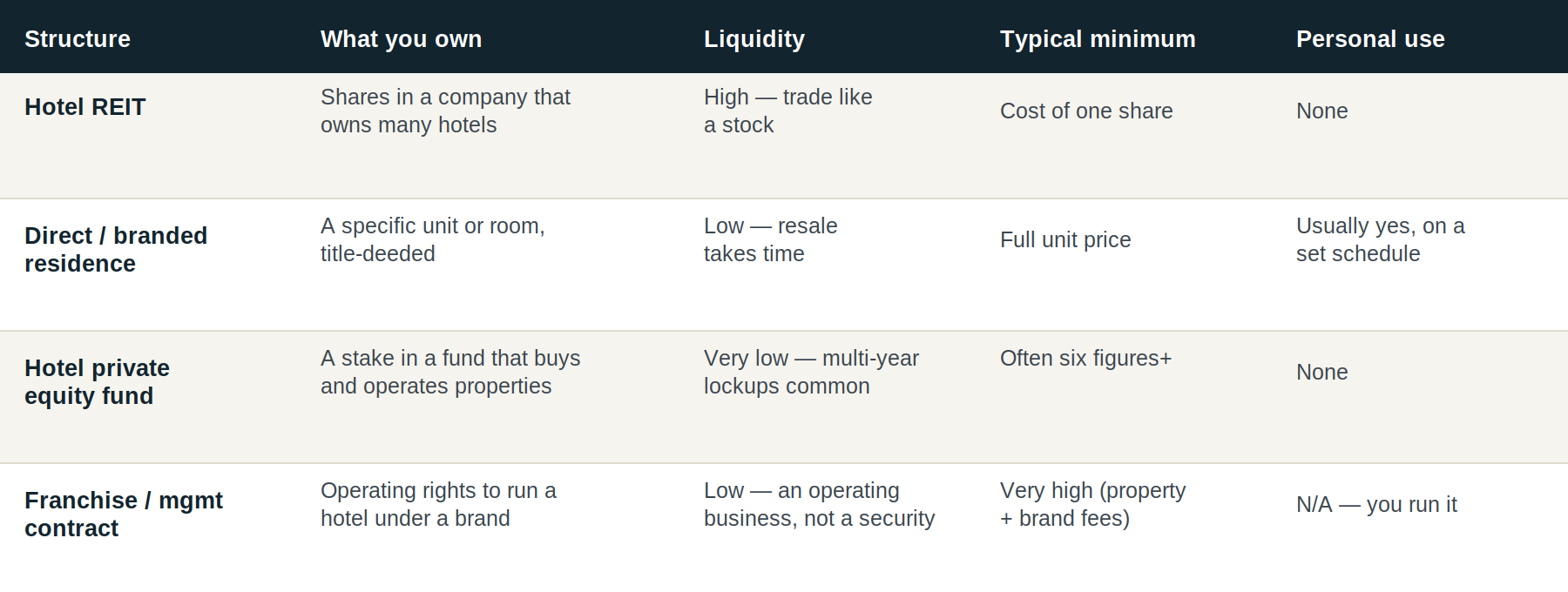
Most individual investors encounter four broad structures:

Hotel investment comparison of REITs, direct hotel ownership, branded residences and private hotel funds

Hotel REITs

A hotel real estate investment trust owns interests in a portfolio of hospitality properties. Investors purchase shares in the REIT rather than owning a particular hotel room.

Publicly traded REITs can provide diversification and liquidity, but investors have no personal-use rights and little control over individual properties.

Direct hotel or condo-hotel ownership

Direct ownership involves purchasing a specific hospitality property or individually titled unit. Depending on the project, the property may participate in a professionally managed rental programme.

This provides tangible real estate ownership but concentrates the investor's capital in a particular property, location, developer and operator.

Branded residences

A branded residence combines individually owned real estate with the name, services or standards of a hospitality or luxury brand.

Some branded residences participate in hotel rental programmes, while others are primarily residential. The exact ownership and management structure should always be checked at project level.

Hotel private equity and investment funds

Private funds pool capital from multiple investors to acquire, develop or reposition hotel assets. Investors typically own an interest in the fund rather than a specific room or apartment.

These structures can provide professional management and access to larger transactions, but capital may be committed for several years and minimum investments can be substantially higher.

Our guide to how to invest in hotels compares these four structures in more detail.

How a hotel actually makes money

A hotel is an operating business built around a real estate asset. Its financial performance depends primarily on how many rooms it sells, the prices achieved for those rooms and the costs required to operate the property.

Two of the most useful hotel-performance measures are occupancy and average daily rate.

Occupancy

Occupancy measures the percentage of available rooms sold during a particular period.

A 100-room hotel that sells 70 rooms on a given night has 70% occupancy.

Average Daily Rate (ADR)

ADR measures the average room revenue earned for each room that was actually sold.

A hotel can therefore improve room revenue by filling more rooms, charging higher rates, or achieving some combination of both.

Revenue per Available Room (RevPAR)

RevPAR combines occupancy and room pricing into a single operating measure. It can be calculated by multiplying ADR by occupancy, or by dividing total room revenue by the number of available rooms.

For investors, RevPAR is useful because it prevents a high room rate from looking impressive when occupancy is weak, or high occupancy from disguising poor pricing power.

Hotel revenue is not investor income

This distinction is essential.

A hotel may generate substantial room revenue without the individual investor receiving the same percentage as a return. Operating expenses, staff, utilities, booking commissions, management fees, maintenance, refurbishment and other costs sit between gross hotel revenue and the amount ultimately available to owners or investors.

When evaluating a hotel investment, always establish whether an advertised return is:

  • gross rental revenue;
  • net rental income after specified costs;
  • a revenue-share projection;
  • a contractual fixed payment;
  • a dividend or fund distribution; or
  • a projected total return that also assumes capital appreciation.

How hotel investment returns work

Depending on the structure, an investor's overall economic benefit can come from several sources.

Three potential components of hotel property investment return: rental income, capital appreciation and personal-use value
Keep contractual income, projected appreciation and personal-use value separate when evaluating an investment.

Rental or operating income

Direct hotel-property owners may receive income from a rental programme, while REIT and fund investors may receive distributions generated from the underlying portfolio.

Capital appreciation

A physical hotel property may rise or fall in value over time. Appreciation should be treated as a potential outcome rather than guaranteed income because the eventual resale value depends on the market and the specific asset.

Personal-use value

Some direct hotel and branded-residence investments allow the owner to stay in the property for part of the year. That can have genuine economic value to the owner, but it should not be presented as cash investment return.

What is a guaranteed hotel rental yield?

Some hotel-property developments advertise a fixed or guaranteed rental return for an initial period.

The word "guaranteed" does not mean the investment itself is guaranteed. It describes a contractual payment obligation whose strength depends on the terms of the agreement and the financial capacity of the entity responsible for making the payment.

The international hotel brand is not automatically that entity.

Before relying on a guaranteed yield, establish who is contractually responsible, what amount the percentage is calculated against, how long it lasts, which costs are deducted and what income structure applies afterward.

Read our guide to guaranteed rental yield programs before comparing projects using headline yield percentages.

Why hotel brands matter

International hotel brands can provide valuable operating systems, standards, marketing, distribution, loyalty programmes and consumer recognition.

But the presence of a major brand does not remove investment risk.

Investors should establish the precise relationship between the brand, developer, property owner and operator. A project can carry a well-known international name while development obligations, construction risk and investor-income commitments remain with completely separate companies.

Evaluate the contract and counterparties as carefully as the brand itself.

Hotel investment risks

Seasonality

Resort and coastal hotels can experience large differences between peak and off-season occupancy and room rates.

Operator dependency

Hotel performance depends heavily on the management team's ability to price, market and operate the property effectively.

Liquidity

Physical hotel property can take considerably longer to sell than publicly traded securities.

Construction risk

Off-plan purchases introduce developer, completion, delay and construction-quality risk before the hotel begins operating.

Currency and jurisdiction

Cross-border investments may introduce foreign-exchange exposure and unfamiliar legal, tax and property systems.

Income guarantee risk

A guaranteed payment depends on the contract and the entity responsible for honoring it.

Management costs

Hotel management, service charges, maintenance and refurbishment obligations can materially reduce net income.

Resale risk

The eventual resale market for an individually owned hotel unit may be smaller than the market for conventional residential property.

Hotel investment vs. residential property

A conventional rental apartment and a hotel investment can both produce property income, but the underlying economics are different.

Residential rental demand is primarily driven by people needing somewhere to live. Hotel demand is generated by temporary stays and therefore depends much more heavily on tourism, business travel, events, seasonality and hotel management.

Hotels can potentially achieve higher nightly rates during periods of strong demand, but they also carry greater operating complexity and potentially greater income volatility.

Investors should therefore avoid comparing a headline hotel yield directly with residential rent without first accounting for occupancy, operating expenses, management fees and other costs.

Who is hotel investing suited to?

The income investor

Primarily interested in income and willing to examine the management agreement, operating costs and net-return assumptions behind the property.

The growth investor

Comfortable entering a developing market or purchasing pre-completion property with a longer holding period and greater development risk.

The lifestyle investor

Values personal use of the property as well as its investment potential and understands that owner stays can reduce rental availability.

Questions to ask before investing in a hotel

  • What exactly am I buying? Shares, a fund interest, a title-deeded property or something else?
  • Who owns the underlying real estate?
  • Who is the developer? What have they completed previously?
  • Who operates the hotel?
  • What is the international brand's actual contractual role?
  • How is investor income calculated?
  • Which costs are deducted before I am paid?
  • Who guarantees any fixed return?
  • Can I use the property personally?
  • What happens when the rental or management agreement ends?
  • How can I sell the investment?
  • Who is the likely future buyer?

Hotel investing on Georgia's Black Sea coast

Georgia's Black Sea coast provides a useful example of how these concepts apply in practice. The region now contains conventional apartments, hotel units, branded residences and large resort developments across markets including Batumi, Gonio, Chakvi and Kobuleti.

These projects can look similar in sales material while carrying very different ownership structures, management agreements and income arrangements.

After understanding the fundamentals here, continue with our comparison of the different ways to invest in hotels, followed by our Black Sea Coast hotel investment guide.

Frequently asked questions about hotel investment

Is a hotel a real estate investment?

Yes, but a hotel is also an operating business. Investment performance therefore depends on both the underlying property and the hotel's ability to generate profitable accommodation revenue.

Can individuals invest in hotels?

Yes. Depending on availability and eligibility, individuals may invest through hotel REITs, direct property ownership, branded residences or private investment vehicles.

Do I need to buy an entire hotel?

No. Some developments sell individually owned hotel or condo-hotel units, while securities and funds provide indirect exposure without owning a specific room.

Are hotel investments passive?

They can be. REITs and managed funds are generally passive for investors, while directly owned hotel units may also be professionally operated through a management programme.

Does a hotel brand guarantee my return?

No. A brand agreement and an investor-income guarantee are separate arrangements. Any guaranteed return should be verified from the applicable contract.

What should I compare first?

Start with what you actually own, how income is generated, liquidity, total costs and the parties responsible for operating and delivering the investment.


Next: choose the right hotel investment structure

Now that you understand the fundamentals, compare hotel REITs, direct hotel ownership, branded residences and private hotel funds side by side.

Compare ways to invest in hotels →

Compare Listings

TitlePriceStatusTypeAreaPurposeBedroomsBathrooms