
Guide 03 · Georgia's Black Sea Coast
Thank you for reading this post, don't forget to subscribe!Black Sea Coast Hotel Investment in Georgia: 2026 Guide
Georgia's Black Sea Coast hotel investment market now stretches well beyond Batumi, with major hospitality and branded-residence projects emerging in Gonio, Chakvi and Kobuleti. This guide compares the main coastal markets, their investment profiles, and the risks to understand before choosing a project.
New to the sector? Start with our Hotel Investment 101 guide or compare different ways to invest in hotels.
Why this coastline, right now
Georgia's tourism numbers have moved well past a post-pandemic bounce. The country logged 7.8 million international visitor entries in 2025, up close to 6% year-on-year, and tourism revenue reached $4.4 billion in 2024 — comfortably above pre-pandemic levels. Batumi, the coast's leading seaside destination, saw international arrivals climb more than 40% in early 2024 alone, and the country's roughly 48,000 hotel rooms are concentrated overwhelmingly in Tbilisi and Batumi, the two cities absorbing most branded hotel investment.
The policy backdrop supports that growth rather than fighting it. Georgia operates under a business-friendly tax regime, while foreign buyers face relatively few restrictions when purchasing non-agricultural real estate. Those advantages are relevant, but they should be considered alongside the specific economics, legal structure and risks of each individual investment.
The five towns, one coastline
"Black Sea coast" isn't one market — it's five towns at very different stages, each with a different reason to be there:
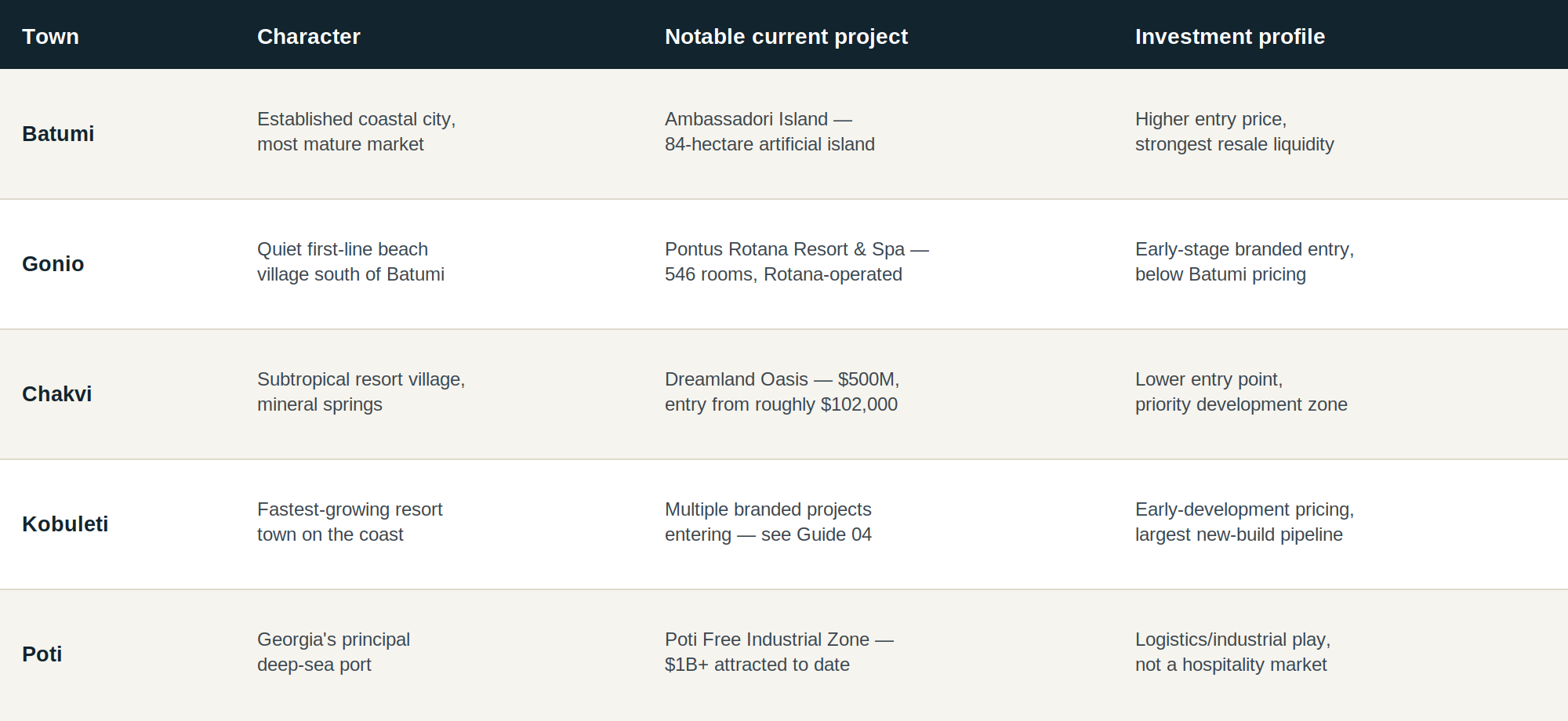
Batumi is the coast's established center — the most internationally branded hotel supply, the deepest resale market, and correspondingly the highest entry prices. It's also where the boldest bets are landing: Ambassadori Island, an 84-hectare artificial island combining residential, hospitality, retail and marina space, made its international debut at MIPIM 2026 with SHoP Architects and engineering firm Arup attached to the masterplan.
Gonio, a quiet first-line beach village just south of Batumi, is where that institutional confidence is now spilling over. The Pontus Rotana Resort & Spa — a 28-story, 546-room development operated directly by Rotana — is being built there specifically as a hotel-room investment product, pairing deeded ownership with a globally recognized hotel operator.
Chakvi, a subtropical resort village around 15km from Batumi known for its mineral springs, has been designated a priority development destination, with the $500 million Dreamland Oasis complex offering entry points from around $102,000 — considerably below Batumi's price floor.
Kobuleti is currently seeing substantial resort and new-build development, with pricing that still reflects a different stage of market development from Batumi. Our Kobuleti guide examines the specific branded projects entering this market in more detail.
Poti is the outlier on this list. It's Georgia's principal Black Sea port rather than a conventional resort market, so its investment case is tied more closely to trade, logistics and industrial development than hospitality demand.
Signs institutional money is already here
Three projects in three different coastal markets illustrate how the region is moving beyond small-scale local development:
Ambassadori Island, Batumi
An 84-hectare artificial island masterplanned with SHoP Architects and Arup, combining residential, hospitality, retail and marina components.
Pontus Rotana, Gonio
A 546-room, 28-story resort operated by Rotana and structured as a hotel-room investment product rather than a conventional residential development.
Dreamland Oasis, Chakvi
A large-scale resort development that illustrates the type of hospitality investment now extending beyond Batumi into the wider Black Sea coast.
What "branded" means on this coast — and what it doesn't
As explained in our guide to hotel investment structures, a hospitality brand can provide design and service standards, access to established booking and distribution channels, and greater international recognition. It does not, by itself, guarantee an investor's yield.
That distinction matters particularly in a fast-developing market where several branded projects may launch around the same time. Investors need to separate the value of the brand from the contractual obligations of the developer, property owner or management company responsible for the investment program.
Foreign buyer basics
Georgia places relatively few restrictions on foreign buyers of non-agricultural real estate, but ownership, taxation and residency are separate issues. For the purchase process and documentation in more detail, read our foreign buyer's guide to property investment in Georgia.
Ownership
Foreigners can generally purchase apartments, houses and commercial property in Georgia without first obtaining Georgian residency or a visa.
The agricultural land exception
Agricultural land is subject to separate restrictions on foreign ownership, making property classification an important part of due diligence.
Residency by property value
Qualifying ownership of non-agricultural real estate valued above the applicable statutory threshold can provide a route to a renewable short-term residence permit. For new applicants, the threshold increased to more than the GEL equivalent of US$150,000 from March 2026. Always confirm the current requirement before relying on property ownership for residency.
Remote transactions
Depending on the transaction and documentation, purchases can often be completed using appropriately prepared powers of attorney and local professional representation.
Due diligence still matters
Foreign-buyer access does not remove the need to check title, registered obligations, the developer, purchase contract and any rental-management agreement before committing capital.
How yield structures typically work on this coast
Coastal branded projects typically use one of three structures: a fixed or guaranteed payment for a defined period, a revenue-share model where income tracks actual rental performance, or a hybrid that begins with a fixed floor before moving to revenue share. The important questions are who is contractually responsible for the payment, which costs are deducted, how long the arrangement lasts, and what happens afterward. Our guide to guaranteed rental yield programs explains how to evaluate these structures before comparing headline percentages.
How to compare Black Sea Coast hotel investments
Comparing projects by advertised purchase price or headline yield alone can hide some of the biggest differences between them. Before choosing a location or development, compare the complete investment structure.
Location and demand
Consider whether demand is primarily seasonal tourism, year-round city demand, resort demand or another economic driver entirely.
Developer and delivery risk
Check the developer's track record, construction stage, contractual completion obligations and what protection exists if delivery is delayed.
Operator and brand
Establish the exact role of the hotel brand and operator rather than assuming the international name on the project is responsible for every contractual promise.
Net income
Compare projected income after management fees, service charges, maintenance, taxes and other costs rather than comparing gross percentages.
Personal use
If you intend to use the property yourself, understand any restrictions imposed by the rental or hotel-management program.
Exit strategy
Consider the likely resale market, transfer restrictions and whether future demand depends heavily on the developer continuing to market new inventory.
See how this plays out in Kobuleti specifically
Kobuleti is attracting a significant pipeline of new resort and branded development while remaining at a different stage of market maturity from Batumi. Our next guide examines the projects entering that market, including Grand Millennium Kobuleti.
Read the Kobuleti investment guide →